Archives for category: Uncategorized

What does Detroit have to teach other cities and creative folks founding start-ups?  Quite a bit, as I found on the Toronto-Detroit-Minneapolis leg of the Agileseed tour.   Basically, Motown was agile before Agile got capitalized.

Talent in the Hive: Part One

Coco in Minneapolis is a space for co-work and collaboration.  It lives in the city’s Grain Exchange building.  The sheer scale of the space dwarfs the notion of individuality and other human-size ideals.  Entrepreneurial possibility is based on combined strength and collective relevance.
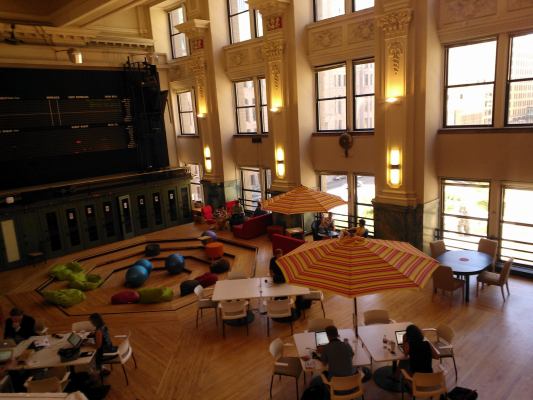
Workspaces are called “campsites.”  But they read more as the geometric cells of a honeycomb.  Literally, the place is humming.
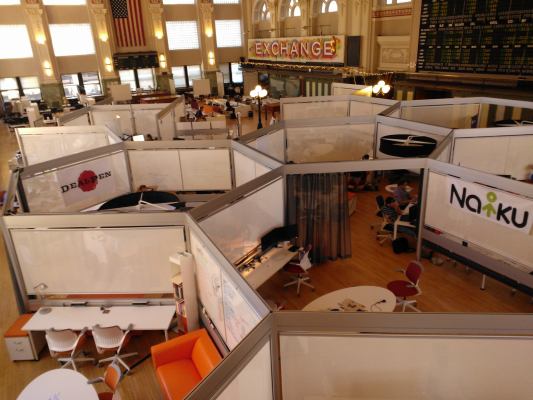
Members include “lawyers, do-gooders, and everything in between” according to the chief organizer Jeke, who took me on a brief tour which mainly consisted of showing me where the elevators were for the Visitors Balcony.   Busy guy!
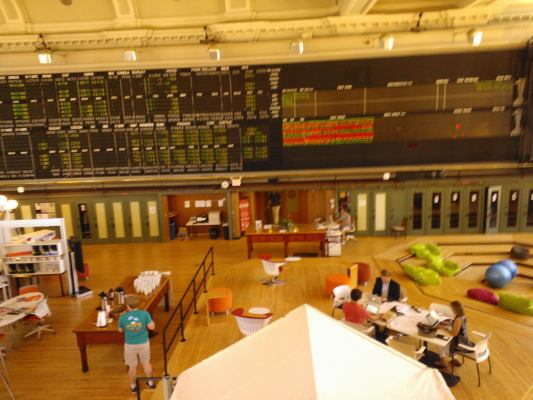
A first come, first serve membership policy differs from the co-work spaces in Toronto and New Haven, where members apply and are considered based on their social contributions.  However, all three co-workspaces seem to have in common a core premise that connects them to the Motown vibe: proximity enhances achievement.

Talent in the Hive: Part Two will delve into the Motown model and why it was agile.
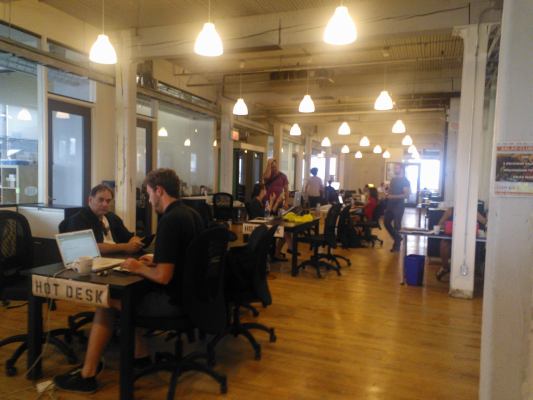
This co-work space in Toronto has had a waiting list since before it opened in 2006.  New offices are now being prepared in Manhattan, constituting a fourth set of spaces for the enterprise.

“CSI” as members call it is a curated mix of nonprofit, creative and tech companies who find value in sharing proximity and infrastructure.

Members also program community events together.

Every entity housed within CSI operates from what the management team calls a “triple win” philosophy – that is, innovation is not pursued for its own sake but as a means to solve social problems.  In the process, these entrepreneurs in the new economy are building community, and fast!

This is a Volvo power steering pump.  It failed.  Twice.  Well, this one only failed once, but it was an attempted replacement for another that had the exact same manufacturing problem.  It pains me to recognize that my garage did not skimp; they bought the best new part available.  This was it.

As a result?  I am still on the road, but only by the goodwill and skill of a mechanic in Raymond, ME – Kevin at Swedish Motors – who took the used pump out of his own Volvo on a day he was supposed to be in a parade.  Actually, he DID drive in the parade, and then came back to the garage and got me all fixed up by end-of-day on a Saturday.  He took one look at the part pictured above and diagnosed the problem: an extra thread in the entry tube, which prevented the O-ring from functioning as a proper seal, allowing all the fluid to escape.

As I write this from Detroit, I think about the relationship between skill and materials.  In making the shapes of civilization, one does not seem free to surpass the other.  They are inescapably intertwined.   However, at the end of the day, a Saturday in fact, at the end of an even longer week, skill appears to have a distinct advantage.  Skill can recognize, source and repurpose materials when necessary, expanding the volcabulary of what’s possible.

So THANKS, Kevin.  I’ll be checking out the Motown Historial Museum today – instead of simpering over an abbreviated trip back home in Connecticut – because you were creative, quick and highly skillful.  And happy to materialize when needed.

Arts, Science, Technology, & Society
The Arts Endowment, the Salzburg Global Seminar, and the Embassy of Austria will webcast a panel discussion today Monday, June 4th, from 5:00 to 7:00 PM EST. “Transcending Borders: The Intersections of Arts, Science, Technology, and Society on a Global Stage” will examine the impact that creativity and collaboration across sectors can have in shaping the world of today and tomorrow.
http://www.nea.gov/podweb/salzburg.html?utm_source=June+4%2C+2012&utm_campaign=June+4%2C+2012+e-newsletter&utm_medium=email

Michael Sahota, keynote speaker at the Agile Games in April 2012 presented by Agile New England at the Microsoft Center in Cambridge, brilliantly references the art of surfing by connecting it with the concept of flow in this article about how we approach fear in our worklives.

“The flow model provides a great way to surf our own personal edges. We are in a state of flow when the difficulty is matched to our capability. By placing ourselves in situations with the right level of challenge, we can confront a fear and work through releasing it.”

http://agilitrix.com/2012/05/deep-insights-around-fear-risk-safety-and-vulnerability/


When the terms are “evolve or perish,” not being creative is no longer an option.  Vijay Vaitheeswaran, global correspondent for The Economist, says that members of the middle class must think of themselves as ordinary entrepreneurs.   Blazing one’s own educational and career path must become par for the course…

http://link.brightcove.com/services/player/bcpid1187410652001?bckey=AQ~~,AAAAGuNzXFE~,qu1BWJRU7c2zPXB5pnS6ytF42ALvFXD6&bctid=1569620290001

The big dot here to connect…?

If this is true, then none other than artists are the ones holding the keys to survival.  Artists’ individual and collective abilities to navigate creative destruction and approach each day’s unrepeatable problems, framing projects that can solve them with fresh thinking, represent the leadership-by-example that is most critically needed in today’s world.

Let’s place a higher value on it.

Yesterday ArtBux had a record-breaking day.  Influencers are following, tweeting, and commenting, and readers are showing up not only from the United States but from Bermuda and Portugal.  I am so happy to provide information considered of value in the space between art and business, the coolest liminal space there is in my opinion!

To mark the occasion, I am reposting the introduction.  Back when the concept for the blog was emerging, these thoughts were in play.  You’ve helped validate some and tipped me along the way through your feedback.

MANY THANKS!   And an early Friday toast to you –  “Clink-Clink-Clink…”

– EBS

***

Enthusiasm is a key to our humanity.   It is a fueling concept for the distinctiveness of the human mind, the patterning of each individual and the diversity of cultures within civilization.   Human beings attach and stay together in groups, from families to cities, based on what we care about.   We require one another to express energy and ideas.   Collectively, our vitality and authenticity can be demonstrated by the pulse of our enthusiasms.

We need stories to help find each other.  In the process of telling stories that make us care in common, we experience belonging.  We come to belong to our enthusiasms – and through them we understand ourselves in context.

My training is in cultural anthropology and urban studies.   My creative background is in visual arts, performing arts and creative writing.  My professional interest lies in the various ways stories are used to help build and sustain culture.  Lifting up against forces of entropy and indifference, storycraft keeps people afloat in the deliciousness of getting to know what it is they care about, and with whom they can delight in the particular enthusiasms that nourish creative people and cultures of choice.

New from The Stanford University Press!   Affirmation of the centrality and universality of storycraft, by the co-authors of Artful Making…

“The Soul of Design explores the uncanny power of some products to grab and hold attention—to create desire. To understand what sets a product apart in this way, authors Lee Devin and Robert Austin… carefully explore the hypothesis that there is something within a “special” product that makes it—well, special. They argue that this je ne sais quoi arises from “plot”—the shape that emerges as a product or service arouses and then fulfills expectations. ”

http://www.sup.org

ArtBux interview with Mr. Devin will have to be coming soon, dontcha think?   Had a chance to meet him at the Agile Games, and participated in his “Deep Dive” session.   Exciting ideas about how practices from theater can take a rightful place within the operational practices of organizations, both for-profit companies and not-for-profit groups.

Software developer turned venture-philanthropist Mario Morino, author of the recent book Leap of Reason, pulls no punches in this text of his speech to the City Club.

In his opinion, “the whole system sets nonprofits up for struggle and starvation, not for solving challenges.”

http://www.vppartners.org/sites/default/files/cityclubspeech_web_0424.pdf

It’s a sobering read, ending on a call to action.

“And I’m also seeing what a difference courageous leaders can make when they become more intentional
in defining their approaches … more rigorous in gauging their progress … more willing to admit mistakes …
and more capable of quickly adapting and improving— all with an unrelenting focus and passion for
improving lives.  We need to supercharge these leaders. “