Archives for category: Uncategorized

Conflict based on personalities is a time drain, wasteful on many levels.  Conflict rooted in differing convictions can be constructive and add value if handled correctly.  Yet doing so takes courage, and that means facing our fears.

company cypher

Openly invite conflict.   People are afraid of disagreement because, in hierarchies, the outcome can be loss of social status.  Invite people to share a multitude of ideas in open forums.  There will be less risk associated with offering the “wrong” opinions, and  communal trust will increase. [1]

Kill the experts.  Any organization that presumes to bring in “experts” is operating in a hierarchical manner.  Call them something else, like “instigators.”  It changes the energy.

Critique ideas, not people.  In the 12-step circles I’ve been fortunate to frequent as a participant-observer, this is known as “putting principles before personalities.”  In a training session on giving feedback, one company I worked with decided to embrace the model of the art critique.  This makes the process of observing what works and what doesn’t fun and engaging rather than scary and full of rejection. [2]

Strictly enforce timeboxes.  When deadlines loom, posturing and jockeying for position simply makes no sense.  [3] Study how theater ensembles manage deadlines: the date for opening night gets published and the public is invited in.  Everyone in the ensemble has a personal, public stake in meeting the deadline [4]

Reinforce goodwill.   Consistent, sustainable quality cannot occur when people treat each other badly.   One company I worked for spelled out its expectation that we would show “respect and candor in all communications.”  Too much candor can descend into brutality.  Overly respectful deference, on the other hand, can put the freeze on important conversations.  So say it, but say it in a nice way.  That’s goodwill.

Be #Flawsome. Show your imperfections and people will automatically feel safer around you.  A group of people doing this will be more united than a team of perfectionists.   Do you believe that awesome imperfection is sufficient to muddle through challenges?  Try it on a small project and see how much anxiety and energy get released for finding creative solutions.

Play with options.  Forum Theater is a way to stop action in a tense or conflicted setting and reinvent new futures.   [5]  The following questions can be posed in writing (to encourage introverts) or in dialogue, or acted out in skits.

  • What would I do if I were brave..?
  • What would I do if I were all-powerful?
  • What would I do if I were in charge?

The Traditions of one worldwide self-organizing group state “So long as the ties that bind us together are stronger than those that would tear us apart, all will be well.”   Here’s hoping that all is well and continues to improve with you and your teams.

REFERENCES

[1] Brindusa Axon, “The Power of Productive Conflict” http://www.scoop.it/t/agile-teams-boosters

[2] Narcotics Anonymous, “Why It Works: The Twelve Traditions of NA” http://www.recovery-world.com/NA-12-TRADITIONS.html

[3] Tom Wujec & Peter Skillman, “The Marshmallow Challenge” http://marshmallowchallenge.com/TED_Talk.html

[4] Lee Devin, “Artful Making” and “The Soul of Design” http://www.sup.org/precart.cgi?id=11662

[5] Sarita Covington, energizing the use of Forum Theater to help organizations and ecosystems http://www.companycypher.com/

ACKNOWLEDGEMENTS

Arthur Fink, for sparking this essay and providing feedback  http://insightandclarity.com/ and http://www.arthurfinkphoto.com/

Michael Romano, for being a trusted and reliable editor

Pictured: Company Cypher, founded by Sarita Covington with another fellow Yale grad.  Coming soon to The Agile Gym (all rights reserved) 

Anyone who has ever sat on a nonprofit Board is familiar with the old joke about the camel…it’s a horse made by a committee.   Decision-making in groups is often fraught with difficulties resulting from politics, personalities and differing communication styles.

Tom Seeley, a bee scientist, has uncovered the main key to how the hive makes good decisions: ENTHUSIASM!  His article in Smithsonian Magazine explains the behavior of female “scout bees” seeking out new sites when a wild hive has grown to the point where it needs to move.

WP_000693

“A scout coming back from an ideal cavity will dance with passion…An enthusiastic scout will inspire more bees to go check out her site. ”  The dance continues until a tipping point of bees has been swayed in a particular direction.  Unanimity is not required, nor even a majority.   Simply a “buzz” great enough to gain attention…sounds like the arts!

WP_000709

The second principle in smart decisions for collectives revealed by bees is flexibility.

WP_000678

Read more: http://www.smithsonianmag.com/science-nature/The-Secret-Life-of-Bees.html#ixzz1ovdQNEmG

Pictured: Choreographer Annie Sailer and Dancers

Annie will lead a Business Agility Workshop presented by Arts Interstices at The Grove in New Haven, CT November 14, 2013

REGISTER NOW: http://businessimprov.brownpapertickets.com/

Special 50% off password only for friends of Arts Interstices:  ARTSINT

Let’s practice smart, on-the-spot decision making!

What’s in the mix for making things flow between people?  Enthusiasm, Curiosity and Desire!  Active, receptive and responsive in kind, these three interpersonal strategies reinforce one another and build lateral engagement in communities.

WP_000730

Enthusiasm means putting it out there.  Let people see your passions and be happy to see theirs.

Curiosity is the moment when you or I decide to cross the threshold that separates us with a blank and an invitation.  Only an open mind can be receptive to new ideas and grow.

Desire is the spark that encourages people to connect.  It means expressing the notion that there are many good things in the space between us just waiting to be discovered.

When in doubt…

  • TRY enthusiasm.  “I like….”
  • TRY curiosity, “I wonder…”
  • TRY desire. “I wish…”

For best results, try all three!

***

I developed this three-part recipe for Wetting the Cement after some intentional experiments with the ingredients during Summer 2013.   Two sets of results were validating.

1. Getting  invited to become more and more involved with the Stoos movement and organizing Stoos in Action  stoosinaction.dk  The core Agile team of organizers was based in Denmark. Fifteen satellites across four continents responded to our invitation to participate.  The “action” was a 6-hour virtual conference dedicated to improving the world of work.

2.  Submitting the idea for a Guinness-approved world record attempt for Largest Chalk Pavement Art to the Awesome Foundation.  Positive community response mobilized over 1,000 individuals, 18 community groups, eight city agencies and a unanimously supportive City Council.  The current world record holder embraced us, not as challengers but as successors.  The Agile community is now interested in the use of scrum to make public art.

In both cases, the individuals could not have predicted what finally occurred.  Enthusiasm, curiosity and desire magnified in an organic way to global scale.

Find out what happens with YOUR special blend in the mix.   Share enthusiasm, curiosity and desire to connect.  I am always happy to hear from you!

ACKNOWLEDGEMENTS:

Deborah Hartmann Preuss A Bigger Game http://abiggerga.me/blog/author/admin/

Akshay Kathari “I Like, I Wish, I Wonder, a framework for providing constructive feedback” https://medium.com/design-startups/ab25a6d5090f

Andrew Bangser, Awesome Foundation, Connecticut Chapter: “What Would You Do With $1000?”  https://www.facebook.com/photo.php?v=734224573257898

Mark Wagner, Drawing on Earth http://www.drawingonearth.org/

CityWide Open Studios (pictured) http://www.cwos.org/

This was a Talkback I prepared for Lisette Sutherland, who could not attend Agile Bill Kreb’s 3D Webinar aired September 18, 2013.  Video at: http://www.agiledimensions.com/blog/video.  Get in touch with me if you’d like a TalkBack prepared for your online event! – ES

wave surger

Speaker Tom Wessel – Davisbase Consulting http://www.davisbase.com/

Interactive Features: Spatial Environment.  Moderator gave lots of voice inflection, made listening engaging. Brought in other senses: made the sound of hands rubbing together, at the questions coming in.  This was a nice moment!

Tom Wessell is founder of Southern Fried Agile Conference…http://southernfriedagile.com/ Regional flavors of Agile can complement and strengthen each other.   Enjoy the chicken, celebrate our thought leaders.  Attendance has gone from 75 to north of 300.  Five different tracks total 20 sessions.  5 PDUs  are like PMP crack!  We do it on a Friday – this year it’s October 18, 2013.  Take the day off and hang out with geeks and freaks and have a good time.

Virtual world graphics used to express metaphors for Agile:

Surfing

It’s a pure sport – a simplistic framework in which you have just a few elements to work with and you must navigate a very complex system.  Execute on the wave, you have to adapt to the motions of that wave.  That’s Agile, applying simple tools to an ever-changing environment.  Otherwise, you end up in the drink!

Pile of Stones

The stones relate to release planning.  There’s a sequential flow of fulfilling requirements that have to be met by a specific date.  Iterations are fixed bucket sizes, requirements are different sized stones.  We arrange them into buckets based on needs of organizations.  Sustainable pace – small pebbles fill in the empty space around big rocks to even the flow.  Takes negotiation between teams and product owner.  There is a logical order to what takes place.

Fossil of Dinosaur Bones

Agile is more than software development and teams.  We as an organization need to evolve and adapt.  Challenges rise as you move up the food chain, it takes more energy to break down the silos and move toward an agile enterprise.  If you do not evolve to be competitive, you will end up extinct.  We are knowledge workers so learning is the bulk of what we do.  If you’re not upgrading skills every two years or so you’re probably falling behind.

Seed

Seeds sprouting in different stages relate to a paradigm shift we are experiencing from command and control structures to allowing for emergent design based on intrinsic strengths.  Project managers have many chances to grow in their development and understanding.  Agile is not a fad.  This is something that has value.  It is growing strong.

Watchmaking versus the Weather

Complicated system versus a complex system.  In the systems we work in, there is too much variability to mindlessly follow a fixed set of plans.  We must inspect and adapt and use whatever we’re learning.  Incorporate a replanning perspective.

Trends are Emerging Patterns.  Here are some:

Pairing a PM with an SM – team focused paired with externally focused.  Scrum Master job is full time, external requirements like compliance takes research and time that a partner can support, esp in a regulated environment.  PM will help navigate that.  Plus this helps agile transitions at enterprise scale by giving a legitimate role for the PM.  SM takes certain skills, empathetic/nanny/psychologist/motivator…not all PMs can make that transition.

SAFe structure -you’re addressing the things that we want to spend money on that fit into a business strategy – end to end system, whole organism – structure will help us evolve

Soft is the new hard.  People skills matter incredibly much.  We are imperfect creatures and hard to work with.  Servant leaders ask: how do I take this group of talented individuals and get them moving in a common direction and becoming high performing?  Then how do we take that to the next level, to the whole organization?

Focus on communication/negotiation/mutual respect – different parts of the organism flexibly say “sure – we’ll reconsider what we were going to do in light of what we are learning about how to make happy customers”  This can be internal or external…making the product owners happy is great.  Barbara Fredrickson’s books tell us that three to one positive to stressful events keep your brain operating at peak efficiency.  http://www.amazon.com/Love-2-0-Supreme-Emotion-Everything/dp/1594630992/ref=sr_1_1?ie=UTF8&qid=1379555688&sr=8-1&keywords=Barbara+Fredrickson

Chief product owner with sub product owners   Complex systems have multiple subsystems.  The voice of the customer includes competing needs and priorities.

Managing your personal WIP so you’re more productive and less stressed.  Our work in progress as thought workers isn’t visible, then at the end of the day we wonder why we’re so tired…what are all the things that are work in progress – make them visible so you can visualize them and understand why you’re so tired. Limit our WIP because we think we want as much work going on at once as possible, but we as humans are not as good at multitasking as we think. Chunking and conquering can be applied to anything in life, that’s what’s great about Agile principles, not just software

Goldilocks Approach to Process: focus on “what is the right level of process to support the flow through the system?”  Not too much, not too little, has to be just right to avoid disconnect without overcommunicating.  This is sophisticated stuff – Agile is evolving, and so are organizations.

Stuart Scott has an interesting title: Chief Conversation Starter.  We’ve been meeting for virtual coffee and conversation on topics related to organizational change. – ES

WP_000645

SS: Any human system exists because individuals are interacting.  A company, an organization, lives and breathes inside those interactions.  So, if I’m in the process improvement business, I’m actually intent on improving the quality of human interactions.

When there’s a process problem, it’s a good bet that either a conversation isn’t happening or isn’t focused on the right issues or isn’t including all the right people.  For example, people in one department will often get together to discuss how they wish people in another department would interact with them. But they don’t actually reach out to the people in the other department to include them in the conversation about how the two groups will interact.

How do we break this?  I like to help groups focus on improving their interactions with other groups, and one tool I like is the “business interaction model.”  It helps people identify the other groups they regularly interact with, and examine the quality of each of those relationships.

ES:  Yes, because most human interactions seem to live in the interstices, the places where various groups come together in an organization, not inside the bounded categories.  I’ve applied the old SWOT exercise of mapping out Strengths, Weaknesses, Opportunities and Threats to these in-between spaces.  Inviting subcultures or groups within the organization to consider how to improve their interactions through this kind of Interstitial Planning (as I’m calling it) seems critical to organizational pathfinding and sensemaking.

SS:  I see enormous value in that.  First you draw a line on the diagram to represent the connection or interaction between two groups.  And then have a conversation about what’s working and what’s not working inside that interaction.  This calls to mind a model of human relationships that helped me understand what I’m responsible for in a relationship with another person.

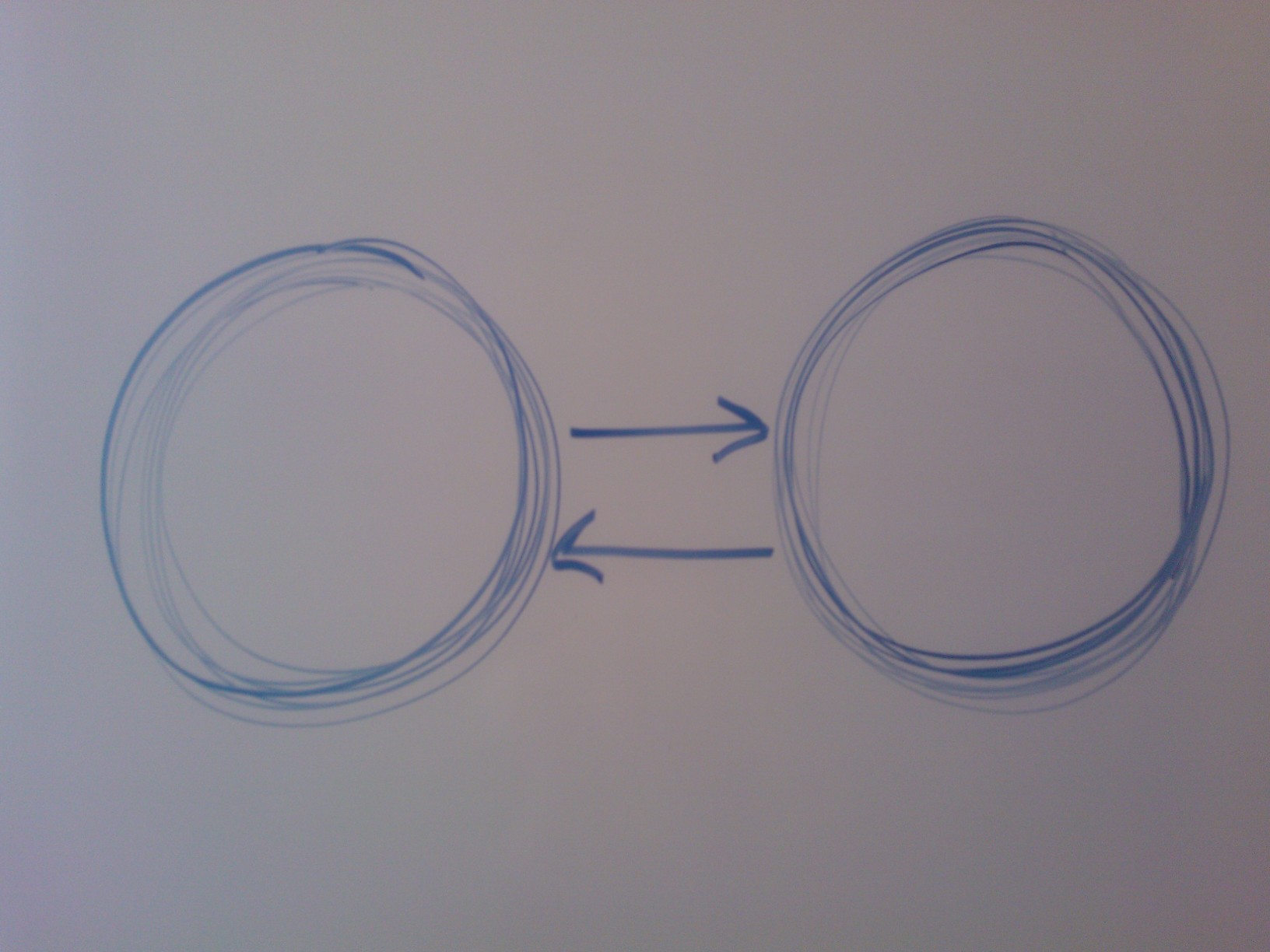
Imagine a piece of paper with two circles for the individuals and a line connecting them.  How do we share responsibility for the relationship represented by that line? How much of that relationship am I responsible for, and how much are you responsible for? Most people I’ve asked have suggested that each party is responsible for 50% of the relationship. The person represented by the circle on the left is thus responsible for the left half of the line up to its midpoint, while the person represented by the circle on the right is responsible for the right half of the line. The goal, it seems, is to meet halfway.

WP_000641 (1)

In practice though, this approach doesn’t work very well. On any given day, I might feel you aren’t owning your full 50% of the relationship. So I might get annoyed with you because you’re forcing me to do more than my share. The only way the relationship can work is if we always believe the other person is doing his or her 50%.

Clearly there are pitfalls.  How about this instead?  Instead of saying that “we have a relationship” represented in our diagram by a single line, we can say that I have a relationship with you represented by a line from me to you, and you have a relationship with me, represented by another line from you to me.

WP_000639 (1)

In this model, I take on 100% responsibility for my thinking and behaviors in my relationship with you. That’s my line across the white space.  My own creation.  That means I can have a productive relationship with you without depending upon you for a certain percentage. Similarly, you are 100% responsible for how you choose to relate to me, regardless of my treatment of you.

Now imagine if you brought that conversation into an interdepartmental squabble.  It might help those human relationships, which are so often filled with confusion and disappointment.

ES:  You might bring the conversation directly into the conflicted space, or you might set it up outside the structure.  In the spaces between departments, systems, and cultures, people can dip into a new way of relating, fill up and then return to their respective positions with greater clarity and perspective.  Like a support group for people trying to find positive ways to handle interactions at work.

You almost need to be in a different space physically, where you can feel a new energy.  That allows you to create what [our mutual friend and colleague] Devin [Hedge] describes as new neural and muscular patterns, in order to go beyond the situations in which the problems originally got created.

SS:  Yes, it can help a lot to set up a different kind of “space” for the conversation if you want the nature of the conversation to change.  That reminds me of how a group of my process improvement colleagues and I set up a weekly conference call so we could stay in a conversation about our efforts to get the right people involved in the right conversations.  Our focus was on how we could contribute in any positive way.  That was five years ago, and we still meet and talk even though we now work for different companies.  People seem to find a lot of valuable in creating this kind of space for sharing interpersonal experiences and challenges within a business. We remember the power of being honest with peers on a regular basis.  Indeed, it’s quite powerful.

ES:  You mention positive contributions. With all the focus on organizational cultures, I’m often wondering how we could create structures that identify and support individuals who are good culture-builders.  I’m working on one now, Scrum of One, which I’ll be bringing to Agile India.  It’s a set of practices inspired by my work over the years with artists and arts organizations.  These practices don’t depend upon a whole enterprise being oriented in any particular way. It’s both ongoing preparation for the creative individuals who get it as well as a way for enlightened organizations to find them so they can work with them.

What if positive culture-builders became fearless at work?  How would business look if we could trust that if a system penalizes them for being authentic, another will be waiting that values them more and is a better match?

SS:  You’re talking about raising the levels of personal responsibility.  In other words, it’s about deciding what I bring to my relationship with you, regardless of how you are behaving toward me. It’s about reaching across the “white space” between the two circles in our diagram above, instead of just trying to meet you halfway.  The motivation for that is not, of course, inside the system.

In organizations, the truly intractable problems span multiple functional areas.  They have no single owner, no single cause, they aren’t linear.  To address these complex problems effectively, we need to create new spaces for conversation so that we invite people to step in and contribute their unique needs and perspectives. I sometimes call this “creating space for the conversations that aren’t happening yet.”

ES:  I can’t wait to see the energy and cohesion that will come when that occurs.

Please find the complete, corresponding audio interview between Daniel Stoelb and Dawna Jones at the end of my guest post here: http://www.frominsighttoaction.com/blog/#!


Image

According to Daniel Stoelb (Leadership and the Lean Five Percent), most change initiatives inside organizations do not place enough emphasis on building trust and establishing integrity.  There is no way, in his opinion, to succeed at a business transformation without first and foremost involving the people you’re leading in the change effort.  Their willingness to respond to the invitation becomes the starting point for everything else.

Listening to a preview of his audio interview with Dawna Jones, I was struck by how long people have been thinking about these things and watching for signs that the realized efforts are starting to crown.  It must be no coincidence that labor means work as well as birth!

 Stoelb’s own epiphany came twenty years ago, when his mantra became “focus on the people side of change.”  He had a chance to enter into a high-conflict, unionized environment and in just one year help settle over 400 longstanding grievances and establish cross-functional teams.  It took three years, he says, to fully open up the space for a positive work culture. The client stuck with the process and achieved validating results.

“The more control you give up, the more control you have.”  That is Steolb’s powerful assertion and, he believes, the paradox of leadership.  He compares it to the process of surrender that a smoker goes through before replacing the bad habit with a positive one.  “The activity of trying to transform creates a sort of structural tension.  A support mechanism becomes necessary. With this support, resolving the tension brings you to a new and better place.”

A combination of co-created vision and process create the adequate container for guiding people in an organization along a successful path.  “Resistance is an overused phrase.  People aren’t resistant to change.  They are resistant to change in which they have no say or input.”

 Crafting a written statement beyond the organizational mission is a critical first step.  “Tell people what is going to occur, what’s in it for them, and when it’s going to occur.”  

Next, gathering input is key.  “Many organizations claim their people are the greatest resource, but don’t act like it.”

 A big part of the problem is the way managers are trained.  “It can be easier to get support for change on the shop floor than from the middle managers.”  Management have been overly focused on skills rather than “the being” of leadership.  

A compelling moment in the interview was when Dawna Jones asked him to elaborate on the idea of tension as an energy that can be harnessed and used for good in an organization.  According to Stoelb, “when the tension diffuses, it creates misalignment.”  According to Jones, when this happens, “blood gets left on the floor.”  She offered the image of change as a spiral: organizations can either spiral up towards expansion and creative solutions, or spiral down towards mess and confusion.  

Stoelb focuses his trainings, communications and presentations on redirecting the energy of conflict so it can be used in a constructive way.  He claims, “most of us, when we look at our personal lives, would admit we are poor at resolving conflict.  It’s no wonder, then, that we avoid conflict at work.”

However, the attempt to avoid conflict is misguided.  “There is no avoiding conflict.  The only way out of conflict is to work through it.”  In Stoelb’s view, that is how we mature, as people, as organizations and as a society. Successfully working through conflict creates sustained change.

Image

“Creating an environment that is empowered and open, where we support people in being part of the change, that doesn’t just apply to business.”  Jones and Stoelb concluded their interview by discussing the social impact of these ideas and the ways in which Lean concepts are being applied in government, the military and all manner of civic and social arenas.  “There’s been a huge shift towards recognizing the value of local relationships, and being more conscious about how how we utilize resources.  The new models for success involve people at the local level in decision making.”


BIOS

Daniel Stoelb is a Lean Sensei and Organizational Transformation Leader living in Kirkland, WA (near Seattle).  He is presently writing two books:  “The Being of Leadership” which goes into further discussion about a values-based, servant-leader mindset, and “The 27 Irrefutable Laws of Organizational Demise,” based on what organizations fail to do when implementing change.  His presentation “So You Wanna Be Change Agent: Lessons from the Trenches – What it Takes to Lead Change in Any Organization” can be found here: http://www.slideshare.net/dstoelb/change-and-why-it-fails

Dawna Jones delivers customized experiential workshops engaging managers, employees and executives in removing hidden barriers to collaboration.  She specializes in leveraging the invisible toward improving speed and accuracy of decisions. Contact her through www.FromInsightToAction.com 


You can also see this piece on the Self Management Institute blogroll at http://self-managementinstitute.org/

Over Labor Day weekend an extraordinary event took place in the world of self organized groups.  Philadelphia, the City of Brotherly Love, hosted the World Convention of one of the largest and most respected 12-Step recovery programs, known as Narcotics Anonymous.  Over 18,000 recovering addicts were in attendance, from over 100 countries.

journey

Twelve-step programs are a massive worldwide movement of various, self-organized groups  – each aligned to address a common, life-threatening problem (alcoholism, addiction, overeating, etc.).  Their power is based on face-to-face meetings in which people identify with one another and share openly and honestly on a regular basis.

This month, twenty years ago, I began studying Narcotics Anonymous as a participant observer for my senior thesis in Cultural Anthropology at the College of William and Mary.  Using Victor Turner’s ideas as a theoretical framework, I titled the thesis “Betwixt and Between: Communitas as Cure in the Lives of Recovering Addicts.”  I have been privileged to spend time sitting inside the circle at NA meetings, discovering how principles like “anonymity,” “humility,” and “surrender” make it possible for men and women whose lives had been controlled by drugs to live clean one day at a time, with each other’s help.

Organic openness is the essence of “Communitas” as outlined by Victor Turner (an underrated genius!  Please read his anthropology essays if you’re at all interested in contemporary organizational culture.  I have recommended them to many Agile coaches and colleagues working to improve the workplace.)

Examples of Communitas throughout history:

  • the monastic tradition established by St. Francis

  • women in Paris in the 1920s

  • performance artists in New York City in the 1970s (the scene fed by collaborations like Merce Cunningham/John Cage)

These groups stepped away from old forms and took for themselves the freedom to experiment with new ones.  Eventually, their ideas fed back into the mainstream where society as a whole could profit from them.  In the end, everyone had more creative options.

Narcotics Anonymous was founded in 1953 in California.  NA describes iteslf as “a global, community-based organization with a multi-lingual and multicultural membership.”   Its message, often referred to as the Promise of Freedom is: that any addict can stop using, lose the desire to use and find a new way to live. http://www.na.org/?ID=bulletins-bull25

This message – shared spontaneously in every meeting by members and read aloud from NA literature – is clear, consistent and reliable.  There is not one single culture for which the message is designed or in which it can be heard and understood.  There is unlimited potential in its simplicity.

Since NA has been fully self-supporting and growing worldwide as a multicultural phenomenon of Self-Organization for sixty years, perhaps we should listen to the wisdom it espouses.

The following is a GAME OF ASSOCIATION.  I start with a principle of Self-Organization, and follow it with a 12-step slogan from Narcotics Anonymous meetings.

Opting in.  “You are a member when you say you are.”

Collaboration.  “I can’t.  We can.”

Simplicity.  “KISS – keep it simple, stupid”

Continuous self-improvement: “Progress not perfection.”  “The journey continues.”

Incremental development. “It’s a process.”  “One step at a time.”

Faith in the emergent solution.  “Trust the process.”  “Act as if.”

Servant-leadership. “Our leaders are but trusted servants.  They do not govern.”

Persistence.  “Stay in the solution.” “Don’t give up five minutes before the miracle.”

In Narcotics Anonymous, the stakes are the highest possible: people’s lives.  In order to have credibility and be able to attract newcomers as well as retain experienced members, it is essential that the organization be able to deliver on its Promise of Freedom.

They cannot achieve this through coercion.  It is only through Self-Organization that recovering addicts have been able to adopt this program of change and incorporate its sustaining habits into their lives.

There is a joke in NA that goes “How many recovering addicts does it take to change a lightbulb?  None!  The lightbulb has to be willing to change itself.”

Therefore, based on everything I have learned in Cultural Anthropology and can offer the workplace improvement movement, culture is more like a liquid than a solid.   It cannot be effectively hacked.  Instead, it flows like a river, carrying various messages along in its fluidity.

Cultural change is driven by those considered to be outsiders or rebels, individuals driven by courage and/or desperation to admit that standard ways of doing things simply DO NOT WORK.   These individuals gravitate toward the margins of organized groups, the interstices, the spaces in-between.   There, they have a better chance of finding each other, learning from one another, and together, eventually, making creative contributions.

  • What is your Self-Organizing group’s primary purpose?  
  • How do its members gather and share this message?
  • Have they experienced enough pain to truly want to change?

For more background on Outsider Wisdom, Cultural Anthropology, Narrative Intelligence and finding the right creative metaphor to spirit forward your self-organizing transformations, please contact Elinor Slomba at artsinterstices@gmail.com.

We have heard it said many times…if you’re not part of the solution, you’re part of the problem.  But what might a focus on solutions look like and feel like?  How can you change your mindset to be more solutions-focused?  I learned a few tips from these coaches this morning at the Scrum Gathering in Barcelona:

http://www.miarka.com/tag/ralph-miarka/

http://www.kotrba.at/

State your goal in positive terms:  If you’re serious about improvement, don’t define your goal as “we need to stop doing X.”  Shift to a solutions-focused attitude by asking “What instead?”  What do you want more of?  If you’re not sure, try and define the exact opposite of the problem.

Start from a position of “not knowing.” Questions build bridges, but only if you’re truly curious.  If a question is posed without authentic curiosity, it will come across as arrogant, sarcastic or hostile.  Each individual is the expert on themselves.  You are isolated on the small, barren island of your own assumptions unless you ask lots of questions and keep being curious.

Small steps can lead to big results. For a team working together, especially for the first time, nothing beats a sense that you’re moving together in the right direction.  But how will you know when a step has been taken towards your goal?  How will you mark and share that knowledge?  Recognizing small steps helps to extend and amplify solutions.

Fear versus incentives.  People’s fears reveal what is at stake for them.  On a project, every fear or concern raised by a team member is a clue to an incentive for success.

Consider the consequences.  To test whether you’ve identified the right goal, try living with the consequences. Make sure you take time to consider how it would feel to experience the achievement of that particular thing….what would be likely to happen next?

Today and tomorrow I live and breathe the world of Scrum, a framework for getting valuable things done in a creative workplace.  The Hotel Fira Palace in Barcelona is hosting a worldwide gathering of the Scrum Alliance, 330 people from over 25 countries dedicated to sharing tools, information and examples of success using the management framework.

Scrum is most often applied to software development projects, but can be used to manage any type of team-based project.  As a storycraft consultant, I use Scrum with most of my clients to manage deliverables.  Compared to the options for managing workflow in other ways, I find consistent validation within Scrum that we are creating high business value quickly.  This makes me want to use  it as much as possible.  Here’s why, more specifically:

Transparency:  The Scrum framework makes it automatically visible, not just to the main point person I’m working with but to the whole company that hires me, what we are working on together and how it solves problems and creates value.

Velocity:  During September, a new client and I collaborated on business proposals and letters of inquiry for new sources of funding.  At the end of a ten-day sprint, based on what was delivered, the client’s feedback was: “Wow…phenomenal!” As a consultant it feels great to accomplish a lot in just a little bit of time, especially when it motivates the client to want to set up three more months of sprint-cycles and releases!

Focus:  Every workplace has a host of competing priorities.  Scrum keeps stakeholders and problem-solvers in the same conversation.  This helps everyone understand what is being accomplished and why it’s important.

Solutions that Work:  Individuals, teams and organizations learn to recognize when a chunk of value has been delivered because, quite simply, it works.   A deliverable is “done” when it works to satisfy a client’s problem.  This may take several iterations.

Perfect as a Verb:  Scrum allows teams – and in my case the “team” is the consultant plus the client – to constantly perfect both the quality of what we produce and the process of how it gets delivered.  We do this through retrospectives and adaptive planning.

If you are curious to learn more about Scrum, go to scrumalliance.org.  Or…to Barcelona!  (Las Vegas….Paris….Berlin…..)

The Gulf Islands Film and Television School on Galiano Island in British Columbia is looking for a new owner.  The present owner/director is retiring and would like to see the school continue and its site kept in productive use.  He is happy to direct on an interim basis during the transition.

GIFTSFilms.com is a creative media epicenter where first time rookies, youth & adults, live with and are mentored by Canada’s top media producers and industry professionals in an intimate camp setting.

I toured Galiano Island this summer on my cross-continental Agileseed Tour.    It is accessible by ferry from Victoria and Vancouver.

Galiano is a special place teeming with creative spirits.   This is the private studio of artist Annette Shaw, who introduced me to George Harris of GIFTfilms:

George would like to hear from anyone interested in learning more about this uniquely urgent opportunity to keep the eyes of the world a little more open and its collaborative art centers alive … he can be reached at  george@giftsfilms.com or by phone – Pacific Time – at (250) 539-9987.