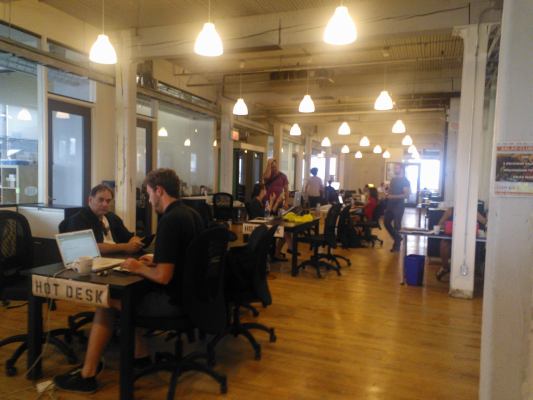
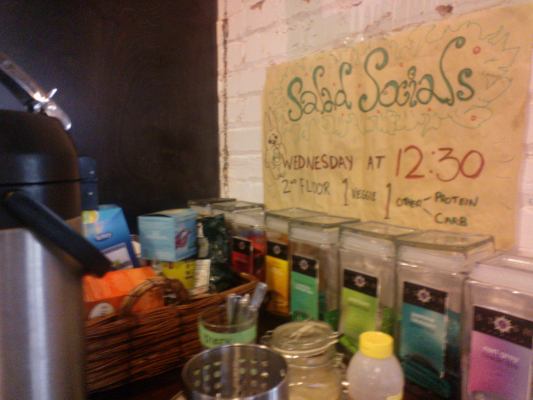
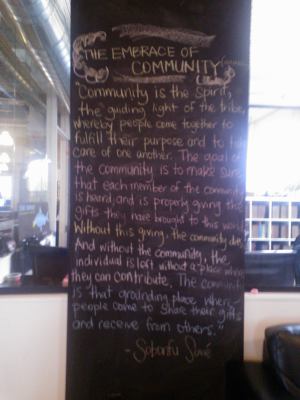
This co-work space in Toronto has had a waiting list since before it opened in 2006.  New offices are now being prepared in Manhattan, constituting a fourth set of spaces for the enterprise.

“CSI” as members call it is a curated mix of nonprofit, creative and tech companies who find value in sharing proximity and infrastructure.

Members also program community events together.

Every entity housed within CSI operates from what the management team calls a “triple win” philosophy – that is, innovation is not pursued for its own sake but as a means to solve social problems.  In the process, these entrepreneurs in the new economy are building community, and fast!

Bates Dance Festival presented a luscious performance by Kate Weare Company on July 28th.  Wisely, the Saturday night programming included an Inside Dance pre-performance talk by dance critic Debra Cash.  Ms. Cash took just the right amount of time to illuminate the choreographer’s approach and give us some reference points.

Kate Weare has built a white hot trending company that does not count beats.  Instead, the dancers co-locate their highly synchronized parts by listening to each other’s breaths.

From the front row, at performance time, I could also hear them breathing.  Knowing their lungs were the bellows to propulse minds, tendons and ball-joints toward precisely executed micromovements added new layers of sensory information and interest.   This is hypersensitivity at its best, derived from the very seat of our animal intellect.

At a certain point, the medium of contemporary dance approached in this way triggers a particular sublimity.  Embodied skill becomes the material from which art is made.

This is a Volvo power steering pump.  It failed.  Twice.  Well, this one only failed once, but it was an attempted replacement for another that had the exact same manufacturing problem.  It pains me to recognize that my garage did not skimp; they bought the best new part available.  This was it.

As a result?  I am still on the road, but only by the goodwill and skill of a mechanic in Raymond, ME – Kevin at Swedish Motors – who took the used pump out of his own Volvo on a day he was supposed to be in a parade.  Actually, he DID drive in the parade, and then came back to the garage and got me all fixed up by end-of-day on a Saturday.  He took one look at the part pictured above and diagnosed the problem: an extra thread in the entry tube, which prevented the O-ring from functioning as a proper seal, allowing all the fluid to escape.

As I write this from Detroit, I think about the relationship between skill and materials.  In making the shapes of civilization, one does not seem free to surpass the other.  They are inescapably intertwined.   However, at the end of the day, a Saturday in fact, at the end of an even longer week, skill appears to have a distinct advantage.  Skill can recognize, source and repurpose materials when necessary, expanding the volcabulary of what’s possible.

So THANKS, Kevin.  I’ll be checking out the Motown Historial Museum today – instead of simpering over an abbreviated trip back home in Connecticut – because you were creative, quick and highly skillful.  And happy to materialize when needed.

2012 is the 30th Anniversary of a true artist-centered community.  It is also, not coincidentally, the 25th year of tenure for Laura Faure, the guiding force that has made Lewiston, Maine a center of creative gravity in the contemporary dance world internationally.  It was meaningful and logical that Bates was the first stop on the Agileseed Tour, as it was from Laura that I first witnessed the curatorial power that comes from trusting self-organization and allowing the inner structure of a collaboration to emerge and reveal itself rather than be imposed.  We worked together for five years finding resources to realize Festival artists’ next best ideas, working at high velocity in the climate of extreme uncertainty and entrepreneurial fierceness that is nonprofit arts fundraising.

The evening’s performance was the award-winning Kate Weare and Company, featuring Kate’s breakout work Drop Down which received an Audience Choice selection when it premiered at The Joyce Theater in New York in 2006.  The company’s newest work in-progress, Dark Lark, will premiere at Brooklyn Academy of Music.  BDF is one of the co-commissioners.

Dining at the college cafeteria beforehand I ran into Boston-based dance critic Debra Cash, who delivers contextual insight to the works performed on stage in the form of Inside Dance Talks.  Another part of her professional life is dedicated to helping companies prepare for and navigate culture change.  We discussed the upcoming Agile Culture conference.

Meanwhile, my oldest son was rhapsodizing about the Festival as a field of earliest memories from when he was toddler-in-tow.  There were a host of children in-residence with their parents this summer, a good sign that the dance world is finding its way toward healthy work-life balance.

Aimee Petrin, a longtime colleague and Director of Portland Arts, presented Laura with a lovely and well-deserved tribute before curtain.  And Laura pointed out the remarkable press the Festival has gotten this summer – including this coverage on Maine Public Television:

http://video.mpbn.net/video/2255629111

Musings in progress…more to follow…

The Agileseed Tour has begun – a cross-continental excursion to arts centers, city halls and creative businesses over the course of 30 days to share innovative ideas and investigate the look and feel of Agile projects in action.   Among the sites I’m most excited about:

Bates Dance Festival in Lewiston, ME

Toronto’s Center for Social Innovation

Detroit’s Motown Museum

Nokia Chicago

Walker Art Center and the Minneapolis start-up community

Helena, MT – Shakespeare, Montana-style, at the Civic Center

San Fancisco’s City Hall and public art

Zero One in San Jose, where art and technology meet to shape the future

and more…because interesting things happen when forward-thinking minds collide.

Meanwhile, the Agile Culture Conference is coming up in Boston and Philadelphia September 13-14, based around the premise that culture has become the gating factor for creativity, learning and productivity in the workplace.

http://newtechusa.net/culture-con/

And the Scrum Alliance is hosting a global gathering in Barcelona, Spain Oct 1-3.  Among the highlights known to date?  Richard Kasperowski of Agile Boston, with details of a radical six-week long Open Space process which resulted in his team’s reconfiguration of their work space to be more human.   http://www.scrumalliance.org/events/464-barcelona–global-event

I would enjoy hearing stories of your own Agileseeding adventures, as well as news of related upcoming events.

CHEERS!

Giving people permission to be creative together in groups, that’s what Scrum Masters do.   On the receiving end, it can feel like a challenge or an invitation, depending on a host of ephemeral factors.  The important thing is for the Scrum Master to have trust in the power of self-organization to come up with solutions that are far better than any one mind in isolation is capable of generating.

http://blogs.versionone.com/agile_management/2012/07/12/how-can-scrummasters-help-their-teams-to-self-organize/?mkt_tok=3RkMMJWWfF9wsRohua7AZKXonjHpfsX64%2BkuUa6%2BlMI%2F0ER3fOvrPUfGjI4GTsNjI%2FqLAzICFpZo2FFOH%2FKGdY9O9ftY

Catalyzing group intelligence is my mission this evening in Hartford, CT, where I will present to the board of directors of Hartford 2000, a coalition of the City of Hartford and its 13 Neighyborhood Revitalization Zones.  The topic? Staff and Board Roles in Nonprofit Fundraising.  We are not following cookie-cutter plans, we are being artful, and that requires a bit more thought and engagement than the average meeting attender is likely to expect.    HINT: color coded gumdrops are involved.

Self-organization takes getting used to, for sure.  However, it is the pattern and flow that best matches today’s thoughtwork and helps us grow beyond an industrial mind-set.  We’ve been post-industrial long enough, time to trigger what’s next!

In my view, that’s a matter for self-organized teams –  supported in working creatively and collaboratively – to decide.

While I was musing aloud about transforming our city’s dingy old water tank into highway-visible public art to announce the opening of its first fine arts center next year, my son asked a very practical question:  how are you planning to get the paint up there?  Details, details, she says, waving her hands around in vague circles…then: enter a team of experts.

Among the latest round of Rockefeller Innovation Fund winners just announced, this one focuses on water as a resource:

http://wordabovethestreet.org/

THEY must know how to get the paint up there!  Right on time, so I can submit the idea as part of a collaborative proposal led by my neighbor and focused on the nexus of sustainability, aesthetics and civic pride to solve urban blight in West Haven, CT.   The big picture includes rain barrels for all – citizens, city parks and City Hall – and drought-resistant native plants on our classic New England Green.  Connecting these dots and others, we are responding to the Mayor’s Challenge, an exciting way to focus those rambling, summertime philosophical discussions over crushed ice, mint and lime:

http://www.huffingtonpost.com/michael-bloomberg/mayors-challenge_b_1594734.html

Don’t creative people have a duty to respond to such challenges?  Oh my, did “creative” and “duty” just pop up in the same sentence?  Yeah, they did.  Still a few days to go before the deadline, and even if we don’t win, we can improve our capacity for big ideas and learn from each other along the way.

Meanwhile, after all these years I only just discovered the secret to a great water balloon fight, revealed by an eight-year-old:  fill the bucket with water first so the balloons don’t break.   DUH! to him, an innovation to me…

Here’s to the rest of a summer filled with ideas that refresh and inspire.

Instructions Not Included: Tinker, Hack, Tweak will take an unexpected look at readymade culture and the objects with which we surround ourselves November 9, 2012 – January 17, 2013 at Artspace in  New Haven.  Meanwhile, in the spirit of the show,  I am organizing a meet-up for industrial designers, engineers and product developers to explore and respond to the work  – and perhaps other exhibits/performances  in the future – as a specially-informed audience.

At Artspace, artists/makers from Connecticut and the surrounding region are invited to submit proposals for consideration through August 30, 2012.  http://artspacenh.org/opportunities.asp?id={FB9554BB-D036-4ABD-ADC6-A31F144EC35E}

At Artsinterstices, industrial designers, engineers and product developers interested in developing a collaborative, contextual response to the selected artists’ viewpoints should contact me at artsinterstices@gmail.com.   The group will convene November to see and discuss the work as it opens.  We will explore and respond to the concepts on this blog in the New Year.  This is an experimental approach to curating audiences from outside the arts who have specialized knowledge and informed insights to share,  for purposes of mutual enrichment and alliance-building among creative enterprises.  An app, if you will, with the exhibit as platform.

I am excited to see what happens next when we put interesting minds together in the space between art and business! – EBS

With provisional space, repurposing and the growing popularity of the “charm bracelet” approach (diverse cultural groups branded together as one district or neighborhood), how do we think and talk about, much less pay for, the iconic showcase-spaces that drive civic PR and tourism?  Here are two relevant and thought-provoking articles:

A sobering piece in the New York Times about building expansions, cultural capacity, and Board members with misplaced enthusiasm: http://www.nytimes.com/2012/06/28/arts/design/study-shows-expansion-can-be-unhealthy-for-arts-groups.html?_r=3

Best read alongside this, for a pick-me-up afterwards:

20 Most Beautiful  Museums in the World, from Flavorwire.    http://www.flavorwire.com/306801/the-20-most-beautiful-museums-in-the-world/comment-page-1#comment-148357

In my opinion, they should have listed 21, with MASSMoCA added to make blackjack!


A former Sprague Electric Company plant, the flat-out droolworthy contemporary art museum in the Berkshires (http://www.massmoca.org/ in North Adams, MA) is thriving, and might offer a few clues to arts groups looking apply others’ lessons and avoid some of the pitfalls:

  • hybridize – old plus new; visual plus performing; art plus technology; science plus humanities.  Creativity is less about invention and more about recombining, so should its containers be!   This is the big limitation of feasibility studies – the holy grail of capital campaigns.  If several others have already done something successfully, chances are you’ll need to put a new twist on it to succeed.  It’s hard to quantify vision, but there’s also no substitute for it and no single discipline, art form or perspective that’s going to compel its narrative forward in isolation.  Build and/or expand accordingly.
  • generalize – niches are nice, but don’t make yours too narrow.  Propose eclectic contents for your container so people will wonder what happens next!  Make sure more purposes are possible in a given space than you ever even imagined at the start.
  • localize – if your proposed architectural project could be somewhere else in the world other than where you’re putting it and still make sense, don’t do it!  Buildings should be indigenous to their surroundings, reinforce their places, and story their communities.

Above all, let’s consider and embrace the notion than everyone is allowed to have an opinion about what makes space important, appealing and interesting, and what spatial alterations and innovations their communities actually need to express cultural vibrancy.   Models, maps and prototypes – tents, carts and flashmobs – might just be the kinds of shrines and palaces that fit these times the best.

Meanwhile City Wide Open Studios is coming up in October 2012 in New Haven, CT – three weekends of feasting on an eclectic free range of art spaces turned inside-out, all invitational-like.  This year is the first to have a theme – Crystal for the event’s 15th Anniversary – making the entire urban area a kind of composite, crowdsourced glittering art palace.   http://www.cwos.org/


Good storytelling is central to leadership.   “A story is the best way to economically communicate understanding and wisdom as well as to nurture passion and motivation.”

http://www.gantthead.com/article.cfm?ID=273851

In the spirit of alliance-building, it is worthwhile for nonprofit managers to see what IT managers are reading and thinking about these days.   Here is some external validation about the central importance of narrative to leading a team.

“Team members on the agile project are typically pressed to stretch limits and proceed where the environment is ambiguous. As such, the team needs guidance on principles and values to shape the way forward and to help them push through challenges.”   That’s where story comes in.