“A guy asked me once on a consulting job what I knew about software development. I told him, I don’t know anything about software development. But I do know how you should do it.” Meet Lee Devin, author of Artful Making: What Managers Need to Know About How Artists Work. This first book, co-authored with Robert D. Austin of Harvard Business School, is regarded as something of a classic in entrepreneurial circles, bringing concepts from theater – “ensemble,” “improvisation,” and “rehearsal” – into the parlance of software developers.

Lately, Lee Devin’s name comes up every time someone in the know learns of my interest in strengthening natural alliances between the arts and start-up worlds. We met at Agile Games 2012 – a conference dedicated to bringing the spirit of play into the workplace to boost productivity – and had a chance recently to speak about his new book, The Soul of Design, published by Stanford University Press. Here are some sample pages:
http://www.sup.org/pages.cgi?isbn=0804757208;item=Excerpt_from_Part_One_pages;page=1
SLOMBA: The Soul of Design does not simply present ideas for consideration, it presents a whole vocabulary.
DEVIN: Plot…coherence…resonance…these are things that make a work of art or a product special or not special. The individual elements are hard to define, but we recognize and understand their sum total when it all works. “I don’t know much about art, but I know what I like.” In this book we’re looking at that “what I like.”
SLOMBA: I’m going to quote from the introduction. “A maker plots a structure to achieve coherence. Coherence presupposes a set of interactions that generate resonance. We call the results non-ordinary.”
DEVIN: Yup.
SLOMBA: What are some relevant changes you’ve seen in the software business since Artful Making was published in 2003?
DEVIN: Certainly in the last few years a change has taken place in the perception of what constitutes a cockamamie idea. There is a new openness. Responses to Agile and more personal and aesthetic modes of thinking about work have a much more positive entry into the conversation than they used to. Back when I started it was pretty hard to get the ideas on the table. I don’t mean to suggest the giant corporation is feverishly making room for this stuff or anything like that, but it does feel like the basic argument – that creative work must be approached in an artful way, a way that factors in human desires and tendencies and allows for an emergent outcome, not a strictly industrial way, a way that decides on an outcome first – has been made and accepted. The difficulties lie in the way people are implementing the new, more collaborative approaches, more in the realms of logistics and space, not people’s attitudes.
SLOMBA: How does your idea of “specialness” differ from the notion of industrial quality, plain and simple?
DEVIN: Homo Aestheticus – I got the idea about that from Ellen Dissanayake, an Ethnologist. One of major jumps we human beings made in evolutionary development was to decorate, to stripe some white clay down our noses, or to put a bison up on the cave wall: to make special. To become individual. This impulse is very powerful. I’m interested in the fact that it points to other skills and tendencies among the people who do it. When a group of humans are aesthetically aware, continually looking to improve their surroundings, it signifies a deeper thing. Homo Aestheticus, because s/he has become an individual, is a much more adaptable creature.

SLOMBA: Do you think choosing a special object can be a creative act?
DEVIN: Absolutely. As an arts market gets established, the citizenry gets divided between makers and partakers. And yet, as Susanne Langer points out, the act of personal response to an art work is just as creative. You notice an object that speaks to you and you have an instant of recognition. This instant doesn’t have a duration; it’s an event. The “Oh, wow.” You’ve made a huge choice in that response and the question then is not whether to follow up on that choice, but how. We look at things, and the process becomes one that Aristotle calls puzzling out the form. This kind of appreciation directly relates to making. The aesthetic experience of appreciating an art form differs only in degree from the pleasure of making an art form. Mind you, the degree is huge.
SLOMBA: Can you talk about originality?
DEVIN: If a thing is completely new, it almost always appears formless. We can’t perceive anything we don’t have a category for. We need some similar experience for comparison, or we just don’t get it. Take a Frenchman to a baseball game, and he’ll just wonder. Like Americans at cricket. People ask the wrong questions, because they don’t know the right ones. They become baffled.
My generation lived through Samuel Beckett. Waiting for Godot is what goes on while you’re waiting for the unspecified, emergent outcome. People said at first, “This isn’t a play. This doesn’t have any shape or form. It’s just gaga.” As long as people put their attention on who or what is Godot that remained the case, because the answer to that question has no relevance. What’s going on on stage is this: people wait. It’s a bleak life, they don’t know what’s going on; they have no short-term memory, much like your humble correspondent. But when actors got up on stage to work the thing out, to puzzle out the form, they immediately got what Beckett wrote. It was pretty hard not to get.

On the flip side, no artist wants to do something that somebody else already did. We want to do something that we do now. Every set of circumstances is unique in time. The solution is unique, but there has to be a familiar context for it.
SLOMBA: In your consulting work you’ve been getting Agile teams to be more creative and artistic; how about an arts group going Agile?
DEVIN: The artists to whom I’ve shown the Agile Manifesto simply look at me and say, “Duh.” “But that’s just common sense.” The principles of coherence and relevance absolutely apply to any object, process or idea. Coherent things, coherent processes and ensembles are going to be more attractive and better at fulfilling their functions, regardless of sector. Aesthetic regard, concern for coherence, is the ultimate in total quality control.
SLOMBA: What do you see down the line?
DEVIN: People are starting to realize you don’t get anywhere if you just pick bad items off the line and scold the guy who made them. Read Deming. Go further upstream and find the conditions that led to the errors in the first place. One of the first things dramaturgs look for when we read scripts is the set of given circumstances. Hamlet, in the throne room, in the second scene of Shakespeare’s play, is deeply pissed off, totally bummed. If you’re an actor or trying to help an actor, you ask: what does Hamlet want? What’s he trying to get? What’s he trying to get away from? Why did he come into this room? And so on and on.
Dramaturgy is a wonderful way to unpack complicated objects and processes. Your boss suddenly loses it…you want to look at that dramaturgically and ask: what are the things that this is the response to? Not causes, given circumstances.
Any process that has room in it for asking these kinds of questions is going to be helpful these days, because things are very complicated. Scrum has room. The tricky thing is that a lot of people don’t know how to ask relevant questions, how to frame what they need to know, what they’re looking for.
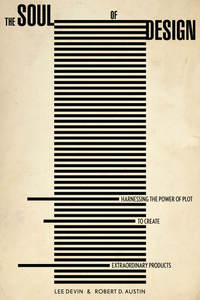
The Soul of Design suggests starting your inquiry with the final cause, the purpose for which the thing is made. For any art object, or any non-ordinary product, the purpose of the thing is to be perfect of its kind. Out in the world, the secondary purpose is to please people who are going to pay you for it. First purpose is prime.
***
Lee Devin’s books can be purchased on Amazon in print form or for Kindle. Here are the links – ENJOY!
http://www.amazon.com/Artful-Making-Managers-About-Artists/dp/0130086959
http://www.amazon.com/The-Soul-Design-Harnessing-Extraordinary/dp/0804757208





 Verge Arts Group